
Kabaddi
Kabaddi's Second Life: From the Mud of the Akhara to the Broadcast Mat
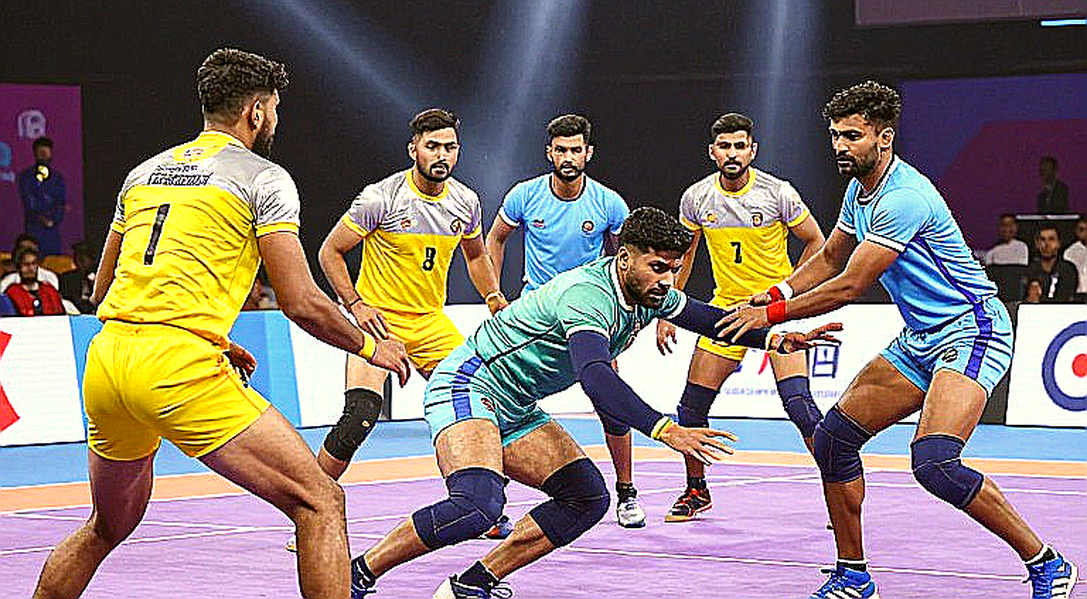
कबड्डी दक्षिण एशिया का एक संपर्क टीम खेल है जो आज दो रूपों में मौजूद है — पारंपरिक सर्कल स्टाइल (गोल अखाड़ा, बिना मैट) और मानकीकृत मैट स्टाइल (एशियाई खेल और प्रो कबड्डी लीग)। मैट कबड्डी में सात खिलाड़ी प्रति टीम होते हैं और एक रेड पूरा करने की समय सीमा तीस सेकंड है; बोनस अंक, सुपर टैकल, ऑल-आउट और डू-ऑर-डाई रेड इसके मुख्य स्कोरिंग नियम हैं। खेल एशियाई खेलों में 1990 से और महिला वर्ग में 2010 से शामिल है। 2014 में शुरू हुई प्रो कबड्डी लीग ने आठ से बारह फ्रैंचाइज़ियों तक विस्तार किया, होम-एंड-अवे प्रारूप, खिलाड़ी नीलामी और आँकड़ों पर आधारित विश्लेषण की संस्कृति शुरू की। लीग का राजस्व मुख्यतः प्रसारण अधिकारों और प्रायोजन पर निर्भर है, टिकट बिक्री पर कम। अंतरराष्ट्रीय स्तर पर ईरान पुरुष वर्ग में भारत का प्रमुख प्रतिद्वंद्वी बनकर उभरा है। मुख्य चुनौतियाँ हैं — व्यस्त मैच कैलेंडर और खिलाड़ी चोट, शासन में पारदर्शिता, दर्शक आधार का कुछ क्षेत्रों में केंद्रित होना, और ग्रामीण स्तर पर अव्यवस्थित चयन प्रणाली।
The best way to understand kabaddi is to see it not as one sport but as two. The first is played on a bare field at the edge of a village — no referee, no whistle, no camera. The rules are oral, disputes are settled by the players themselves, and the only evidence of victory is exhaustion and dust. The second is the one that appears on television: whitewashed lines on a synthetic mat, every raid logged as data, every tackle reviewed from multiple camera angles, and a single bonus point carrying the attention of millions.
Both are the same sport, but their ecosystems are entirely different. The first kept kabaddi alive for centuries; the second turned it into an industry. Kabaddi's position in India and South Asia today is rare among traditional contact sports anywhere in the world — it has neither disappeared nor fully modernised. That is simultaneously its greatest strength and its greatest weakness.
Rules: a game of thirty seconds
The basic structure of kabaddi is deceptively simple, and that simplicity is the first condition of its global acceptance. A raider crosses into the opponent's half, chants 'kabaddi' continuously, touches one or more defenders, and returns to his own half. If he returns without pausing, without breaking the chant and without crossing the boundary line, his team scores for every defender touched. If the defenders stop him, the points are theirs. On the mat, a raid must be completed within thirty seconds — a rule that made the sport broadcast-friendly because it makes tension measurable.
Then come the finer rules that form the real arithmetic of modern kabaddi. The bonus point: if a raider touches a defender within the first line, he earns an extra point. The super tackle: when defenders stop a raider while they are down to three or fewer men, they earn two points instead of one. The all-out: when every player of one team is out, the opposition gets two additional points and the entire team returns to the mat. The do-or-die raid: on a third consecutive raid, a raider who fails to score is compulsorily out.
These rules make kabaddi a sport in which risk has direct, immediate value. In cricket you can bat out ten overs without taking a risk; in football you can defend for an entire match. In kabaddi that is impossible. Every thirty seconds demands a decision, and every decision either yields points or costs a player. That continuous pressure is kabaddi's biggest broadcasting asset.
Circle style and mat style: two physical languages
The two main forms of kabaddi still coexist. Circle style — also called Punjabi kabaddi — is played in a circular arena without a mat, allows up to seven defenders, and relies on wrestling-like tackling technique. It is popular in Punjab, Haryana and parts of Pakistan and has its own separate tournament circuit. Mat style — used at the Asian Games and in the Pro Kabaddi League — is played on a rectangular mat with seven players and far more standardised rules.
The difference is not merely technical. Circle-style players are built differently: strong upper bodies, wrestling grips, the ability to stay glued to the ground. Mat style rewards speed, balance, rapid changes of direction and collective coordination. A player moving from one format to the other must change not just his understanding of the rules but his physical language. That is why talent identification in India runs through two separate pipelines that often do not see each other.
The Pro Kabaddi League: a structural shock
Launched in 2026, the Pro Kabaddi League fundamentally altered the sport's economic and cultural architecture. It began with eight franchises and later expanded to twelve. What changed most was visibility — for the first time, a kabaddi player had a face, a name and a durable identity on national television.
The league's cleverest structural decision was the home-and-away format. When teams play in their own cities, the sport connects with local audiences and creates a market for local sponsors. That is something a national tournament cannot do: national teams represent, but they do not put down roots. The league tried to convert kabaddi from a sport of states into a sport of cities, and largely succeeded.
The second great change was data. Raid efficiency, tackle success rate, super-tackle frequency, performance in do-or-die situations — none of this was ever recorded before. Once numbers arrive, coaching changes, selection changes and strategy changes. In traditional kabaddi, experience and instinct were decisive; in professional kabaddi, calculation is becoming decisive.
Economics: from auction to broadcast rights
The centre of kabaddi's commercial economy is the auction. Players are categorised and franchises bid for them. This arrangement does two things at once: it produces a sudden, large jump in player income, and it creates pressure to maintain competitive balance between teams. A good raider can now reach an income level that two decades ago was available only to cricketers — a remarkable shift in itself.
But this economy has a basic vulnerability: the bulk of revenue comes from broadcast rights and sponsorship, not ticket sales. That means the league's success depends on viewership, and viewership depends on the broadcaster. If numbers dip even slightly in a season, the effect lands directly on team budgets. In cricket, the spectator in the stadium is also a major revenue source; in kabaddi that share is still small.
The second challenge is spending inequality. Teams in larger cities lead on sponsorship; teams in smaller cities lag. If that gap widens, the league's competitive parity — its greatest quality — could weaken. A league in which the same two or three teams win every year loses viewers, and kabaddi must manage that risk continuously.
The player's life: from village to mat
Kabaddi's most distinctive feature is that its players usually come from precisely the regions where the sport has traditionally been played — rural Haryana, Uttar Pradesh, Punjab, Tamil Nadu, Maharashtra, Telangana. The sport emerged not from urban club culture but from mud akharas. The advantage is a deep talent pool; the disadvantage is that the route to that pool is unsystematic.
When a village player turns professional, he does not merely change his training — he changes his entire economic position. The household's income base shifts, his social standing shifts, and expectations suddenly arrive as a weight. This is the least discussed and most human part of kabaddi's story.
Injury raises a different question here. Kabaddi is a contact sport involving falling, gripping and stopping; knee, shoulder and back injuries are common. The professional league introduced a culture of injury management, but it has not yet reached the level where a player's career is protected in the long term. A kabaddi player's peak is short, and one serious injury can end it midway.
The international picture: Iran and beyond
Internationally, kabaddi's story was one-sided for a long time. The sport has been part of the Asian Games since 2026, and India dominated it for the first two decades. But in recent years Iran has emerged as India's strongest challenger in the men's game and has beaten India in major tournaments. That shift matters because it shows kabaddi is no longer purely an Indian sport — its technique is developing elsewhere too.
Iran's rise also offers a model: a centralised, disciplined training system built on physical preparation. Where Indian kabaddi's strength is diversity and instinctive talent, Iran's is structure and continuity. Over the long run, structure tends to beat instinct — a pattern seen repeatedly in other sports.
In South Asia, Bangladesh, Nepal and Sri Lanka have strong domestic traditions of their own but still have a long road to global-level performance. Kabaddi is also expanding in Africa and Central Asia, though it remains early days.
Women's kabaddi: the fastest-growing segment
Women's kabaddi entered the Asian Games in 2026 and has grown steadily since. The Indian women's team has performed consistently at international level, and Iran, Chinese Taipei and Thailand have become competitive. Domestically, the women's structure is weaker than the men's, but its growth rate is higher.
Women's kabaddi matters for more than the sport's expansion. It also challenges the social framework in which participation in physical sport is not easy for rural girls. When a village girl raids on the mat, she is not just scoring points — she is breaking a norm. That is why the women's game is kabaddi's most forward-moving story, even if its market is still small.
Grassroots structure and selection
Kabaddi's talent pipeline runs mainly at three levels: local village and block-level tournaments, state competitions, and institutional national-level events. The first level is extremely informal and leaves no centralised record. The second is uneven — some states have strong structures, others do not.
The direct consequence is that much talent is lost at the very first level. A player who cannot assemble the information, contacts and money needed to reach a state team is never seen. This is modern kabaddi's biggest structural challenge: the top of the pyramid has professionalised, but the base remains informal.
Challenges: sustainability, calendar and governance
The first challenge is the calendar. A dense league season combined with international commitments places a heavy load on players. Kabaddi is physically expensive and injury rates rise when recovery time shrinks. Any league's long-term success depends on how durable it makes its players, not on how much it spends on them.
The second is governance. When a sport commercialises quickly, regulatory and organising roles should separate, but often they merge. The status of players' associations, contract terms, dispute resolution and anti-doping arrangements all require clarity. Without transparency here, trust weakens — and trust is the real capital of any league.
The third is concentration. Kabaddi's audience base is still clustered in a few regions and a few languages. Becoming a national audience requires the sport to take root in places where it is not traditionally played. Having a team in a city and having a kabaddi culture in that city are different things, and the league must work on the second.
Conclusion
The most interesting thing about kabaddi is that it chose a path to modernity without losing its roots. It is neither fully traditional nor fully commercial. Its strength is a depth of talent no new league could buy; its weakness is that this depth still travels along a disorganised route.
If the next decade is to be kabaddi's decade, the sport must decide where investment goes. The spectator in the stadium, the structure of women's kabaddi, data and selection systems at the rural level, and player health — these are the four areas that will determine whether the sport remains what the last ten years made it, or becomes something considerably more. The sport is not competing with itself; it is competing with the framework in which it operates. And that framework is still being built.

संबंधित खिलाड़ी
अनुशंसित
Commonwealth Kabaddi Championship 2026, India vs England: Match 4 Is India's Opener — The Question Isn't the Scoreline, It's the Field2026-10-24
Crore Bids, Railway Salaries: Where Kabaddi's Real Transfer Market Actually Runs2026-11-11
The Line Struck Off the Draw Sheet: Pakistan's Exit, the Arithmetic of Thirteen Nations, and the Circle-Style Burden2026-10-23
Match 4 That Is India's Opener: In Ahmedabad, Read the Team Sheet, Not the Scoreboard2026-10-23
Kabaddi: From the Village Akhada to the Global Stage2026-11-01
Kabaddi Champions League: The Rs 5 Crore Purse, a Rs 17.4 Lakh Record, and an Open Ledger2026-11-06
Surjeet Singh Named India Captain, Naveen Kumar Deputy for Commonwealth Kabaddi Championship 2026: What the Announcement Leaves Out2026-10-23
अनुशंसित
Fourteen Becomes Thirteen: Pakistan's Exit Did Not Shrink the Commonwealth Kabaddi Title, It Cheapened It2026-10-23
Commonwealth Kabaddi Championship 2026: India's Three Wins, Nigeria's 49-Point Gap, and Iran's Empty Chair2026-10-28
Surjeet Singh Named India Captain, Naveen Kumar Deputy for Commonwealth Kabaddi Championship 2026: What the Announcement Leaves Out2026-10-23
India vs Nigeria: At the Commonwealth Kabaddi Championship, the Real Test Will Be the Margin of Victory2026-11-12
The Rise of Kabaddi: From Mud Pits to the Global Stage2026-11-02
Analysis Unavailable: Match and Player Details Required for the Original Sports Report2026-11-09
Commonwealth Kabaddi Championship 2026: The Truth Behind India's Wins — What '3-0' Really Means Without Iran2026-11-06